Friday, March 09, 2007

New Mexico fires back

NOW, THEREFORE, BE IT RESOLVED BY THE LEGISLATURE OF THE STATE OF NEW MEXICO that, as Pluto passes overhead through New Mexico's excellent night skies, it be declared a planet and that March 13, 2007 be declared "Pluto Planet Day" at the legislature.


This could be a new civil war, Pluto planet states versus Pluto non-planet states. Ugly.

Wednesday, March 07, 2007

why we should go

The following op-ed piece appeared in the Washington Post earlier this week.

Music of the Spheres
Why a Moon Mission Is Worth the Money

By Charles Krauthammer
Friday, March 2, 2007

You might not have noticed, but we broke another U.S. space record last month when astronaut Michael Lopez-Alegria logged his 67th hour of spacewalking. If you consider that the equivalent of the Guinness record for pogo-stick bouncing ( 23.11 miles in 12 hours and 27 minutes) -- amazing but pointless -- I agree with you. There's nothing quite as beautiful as the space station and the shuttle that services it, and nothing quite as useless.

Now, that can be said of many things: a balance-beam dismount, a Shakespeare sonnet, a chess problem by Nabokov. But none of these is financed by taxpayers, and none makes a claim to utility. They are there for reasons of aesthetics, and perhaps amusement.

You cannot justify a $17 billion NASA budget or $6 billion for manned exploration on such grounds. There has to be more than that, and the space shuttle never was. It will be remembered as one of the most elegant, most misbegotten detours in the history of technology. It was our Spruce Goose, Howard Hughes's gigantic, eight-engine plane that flew only once.

But the Spruce Goose didn't cost $4 billion in tax money to operate. Which is why the coming retirement of the shuttle is so welcome. Even more welcome was the Bush administration's decision to redirect the entire manned space effort toward establishing a moon base.

Not until about 2020, mind you, half a century since we first reached the moon. Future generations will have a hard time understanding the hiatus. But for two sets of critics -- the Luddite left and the science purists -- 50 years is not nearly long enough. They would not build a moon base at all.

The Luddites have long opposed manned exploration as a waste of resources when, as the mantra goes, we have so many problems here on Earth.

I find this objection incomprehensible. When will we stop having problems here on Earth? In a fallen world of endless troubles, that does not stop us from allocating resources to endeavors we find beautiful, exciting and elevating -- opera, alpine skiing, feature films -- yet solve no social problems.

Moreover, the moon base is not pointless. The shuttles were on an endless trip to the nowhere of low Earth orbit. The moon is a destination. The idea this time is not to go to plant a flag, take a golf shot and leave, but to stay and form a real self-sustaining, extraterrestrial human colony.

Sure, Mars would be better. It holds open the possibility of life and might even have water on its surface today. But the best should not be the enemy of the good. Mars is simply too far, too dangerous, too difficult, too expensive. We won't go there for a hundred years.

Nor is it true that there is nothing of use or even of interest on the moon. There are all kinds of materials to be exploited, observations of the cosmos to be made and knowledge to be gained on how best to live off the land away from Earth.

A century ago there seemed to be nothing in Antarctica, either. We went there first for adventure, then for discovery. The concrete scientific advances Antarctica has yielded (regarding climate change and the ozone layer, for example) have been as important as they were unexpected.

A more serious critique of returning to the moon comes not from the Luddites but the purists. They want science, and they are right that robotic exploration is a more cost-effective way to get it. The science yielded by unmanned vehicles, such as past and future probes of the ice surface of Europa and the hydrocarbon lakes of Titan, is indeed thrilling. And pound for pound, dollar for dollar, manned exploration does bring back less science than robots.

But it still brings back science. Humans can discover things through intuition and pattern recognition that machines thinking in algorithms cannot. Imagine the scientific possibilities if today we had humans patrolling Mars rather than the brilliantly programmed but still limited golf carts now roaming the surface.

And then there's the glory. If you find any value, any lift of the spirit in a beautiful mathematical proof, in an elegant balletic turn, in any of the myriad human endeavors that have no utility but only breathtaking beauty, then you should feel something when our little species succeeds in establishing new life in a void that for all eternity had been the province of the gods. If you don't feel that, you are -- don't take this personally -- deaf to the music of our time.


----------------------------

I posted a while back on this topic and made some similar points. NASA has a long way to go to recapture the adventure, awe, and pride of the Apollo program, but it deserves the chance. History will record the shuttle program as a very expensive middling between two eras of lunar exploration, but the timidity of the shuttle program should not condemn the efforts of NASA's human space exploration efforts going forward. It is easy to make arguments against spending the amounts of money space exploration requires, and NASA has had to survive on a leaner budget in recent years because of those arguments. However, Mr. Krauthammer makes the valid point that there is no end to earthly problems so why not try to elevate our existence with the beauty we can experience. I have witnessed people looking through a telescope for the first time, and for many it is a moment of great excitement and wonder. If people can get so excited about the relatively fuzzy images they see through a telescope, I find it hard to believe they won't get excited about humans traveling to the moon. The accomplishment is so far out of our everyday experiences that it just cannot be ignored or diminished. The Apollo program inspired a generation of young Americans to become scientists and engineers, the very people that lead this country in technical accomplishment today. Put a dollar value on that. The next generation is waiting.

Friday, March 02, 2007

Saturn, like we've never seen it

This is a new image from the Cassini orbiter, featured on the CNN website today. The image was taken while the Cassini spacecraft was in a high inclination orbit, meaning that the spacecraft was traveling at high latitudes. The image looks down on the planet, fully exposing the ring plane as a complete circuit of the planet. The detail is overwhelming. The disk of Saturn is a little overexposed, I imagine that is necessary to bring out the detail in the ring structure. This is an example of an astronomical image that cannot be acquired from Earth, we had to go to Saturn to get an image from this angle, there is no other way.

Thursday, March 01, 2007

check out your world

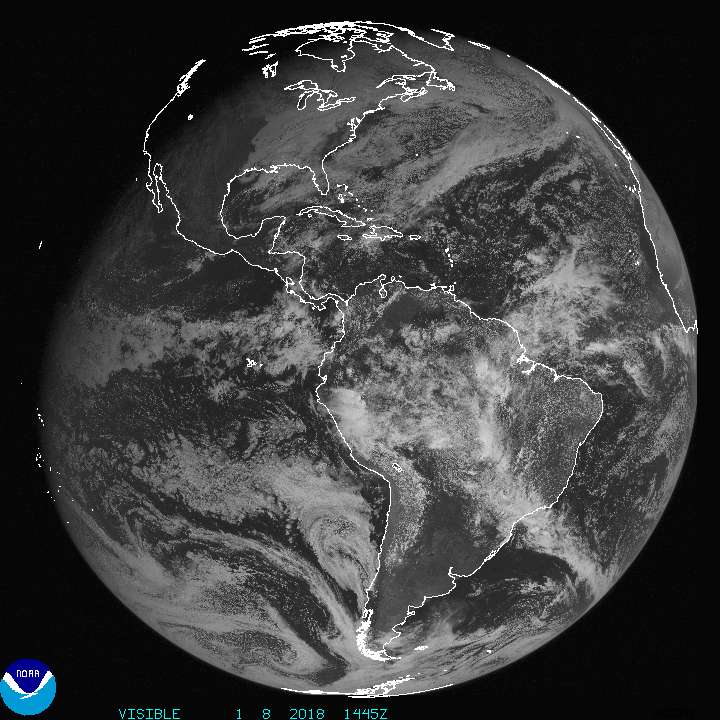
The image here is from the GOES West spacecraft, a geostationary spacecraft that provides visible and infrared imagery of the Earth in addition to other geophysical data. GOES stands for Geostationary Operational Environmental Satellites, of which GOES West is just one. The fleet of spacecraft orbit the Earth at 6.6 Earth radii, or just over 22,000 miles above the Earth's surface. Orbital mechanics operate such that at this distance a satellite orbits the Earth at the same speed as the Earth itself rotates. The result is a satellite permanently fixed above a single point on the Earth's surface. In the case of GOES West, that spot is far out in the Pacific Ocean. The spacecraft is able to continuously monitor an entire hemisphere from this vantage point. Hawaii is outlined up and to the left in the image, while North and South America are on the right. This image was taken just a few hours ago. I love looking at these images from time to time, they capture the beauty and enormous detail of our planet in a single frame.

http://www.goes.noaa.gov/goesfull.html

lunar eclipse this weekend

Feast your eyes on the moon saturday night as it will be passing through the shadow of the Earth, a truly enjoyable astronomical event. A lunar eclipse occurs when the Earth lines up in between the sun and the moon. The moon passes through the shadow of the Earth and takes on a palette of red colors. The red coloring is from sunlight passing through the Earth's atmosphere, just like a sunset generally looks reddish orange. The eclipse will be best seen from the eastern United States, beginning a little bit after sunset and lasting for a couple hours. Unfortunately, we western state types will not see any of the eclipse. The consolation is that a second lunar eclipse this year occurs on August 27th, and the western United States will be the prime viewing region.

Saturday, February 10, 2007

An Inconvenient Truth

I finally managed to see Al Gore's film on the environment and global warming today and I give the film a big thumbs up. Yes, the film can definitely be viewed as the centerpiece of a Presidential election vehicle and yes, the film contains a few too many wistful scenes of Al gazing out windows, but I give him high marks for trying his best to not only understand the science of global warming but present it to a mass audience without dumbing things down too much. The film moves back and forth between scenes of Gore giving his now famous lecture on global warming and glimpses into his life story and the parts that are relevant to the environmental movement. In his lecture, he shows the actual data that so clearly proves how we have changed our atmosphere. He exposes some of the absolutely irresponsible moves that have come out of the Bush White House regarding global warming, including the editing of scientific findings by a non-expert. Gore places the burden of proof upon himself, spending 90% of the time simply trying to convince us that the evidence is real before switching gears to tell us what we can do. My favorite aspect of the film is the presentation of data: atmospheric carbon dioxide levels, global population growth, global temperature trends, sea ice reduction, all presented on visually impressive graphs with Gore's caring and involved narration of their meaning. This is an important film, I highly recommend it.

www.climatecrisis.net

Tuesday, February 06, 2007

astro-nuts

Today was one of those pleasant days in the news where all the misery of the planet is pushed aside for a particularly bizarre story. The astronaut love triangle that has resulted in kidnapping and attempted murder charges for a recent astronaut is the stuff of a saturday night live skit, not the real world. I don't particularly care about the details, what I care about is making sure people keep this incident and the state of the overall astronaut corps separate. Lisa Nowak is clearly a troubled person, but her actions are not indicative of some kind of pervasive rot within the astronaut corps or the culture of NASA. Astronauts are a culturally diverse, highly educated, and extraordinarily brave group of people, but they are also human beings and even the best of us blow a gasket from time to time. Does NASA need to review some of it's psychological testing procedures for astronauts? Absolutely. But the idea that the astronaut corps is an unstable powder keg of psychos is just wrong. Unfortunately, this incident will likely be used as a broad brush to paint the astronaut corps as a mental pressure cooker and NASA as a failed manager of it's most visible employees. We've been spared the awful news of the world for a day, let's get back to worrying about the truly crazy people out there.

Sunday, February 04, 2007

Iraq wetlands on the mend

The enormous wetlands of the Tigris-Euphrates river basin, the home of the Mesopotamian civilizations of thousands of years ago, are making a comeback. The wetlands were systematically drained during the Hussein regime with little regard for the Iraqis who relied on the marshes for their livelihood and the wildlife that called them home. With the help of American forces, independent contractors, and ordinary Iraqis, 40% of the marshlands have been reflooded since 2003. Full ecological recovery is a long way off, but a clear sign of progress is the return of thousands of water birds to the region.

Tuesday, January 23, 2007

Crescent moon, rapid

I took this picture not even 30 minutes ago on the roof of my condo complex and here it is ready to show off. I love digital astrophotography.

Saturday, January 20, 2007

Saturn

A new first for my 5" telescope was my viewing of Saturn last night. Saturn currently rises in the eastern sky well after sunset and gets high in the sky towards midnight. I captured the image above with my small CCD camera using 0.177 second exposures stacked and averaged to bring out the details. The rings are obvious and I could convince myself that the large gap in the rings, the Cassini Division, is visible but I'll leave that to the viewer. A cloud band on the upper portion of Saturn itself may also be visible. Regardless of the details, the image definitely captures the subtle pastel colors of Saturn.

Comet McNaught


I hope everyone at least tried to see Comet McNaught during early January, it really doesn't get much easier to see a comet than it did for McNaught. Naked eye comets are fairly regular, every few years maybe, but McNaught was especially spectacular. Unfortunately for us southern California types, the comet was low on the horizon. I only saw it one night from my location, in retrospect I wish I had stopped near the ocean one night to see it well. My sad picture at top above barely admits the presence of a comet, but it's there near the center on the horizon. The image below mine shows a beautiful sunset image of the comet taken by Jens Hackmann in Bad Mergentheim, Germany on January 7.

I have now seen three naked eye comets in my life. Hyakutake in the spring of 1996, Hale-Bopp in April 1997, and now McNaught. I plan to be around when Halley's Comet makes another pass through the inner solar system, in mid 2061. I will be 86 years old, let's hope the eyes hold out.

Wednesday, December 20, 2006

Astronomy Cast

If you are interested in an accessible discussion of astronomical topics I recommend Astronomy Cast, a new podcast. Astronomy Cast is available each week and is about 30 minutes in duration. Recent topics have included supernovae, dark matter, meteor showers, and getting started in amateur astronomy. Fraser Cain and Pamela Gay from Southern Illinois University offer an enjoyable tour of some of the major topics in astronomy.

astronomycast.com

A new take on coal in the stocking

The following is from Tom Toles of the Washington Post.


winter solstice

Today at 7:22 PM winter solstice 2006 arrives, the shortest day of the year and the beginning of winter in the Northern Hemisphere. I'm currently in Buffalo, NY, the media ordained cold capital of the universe, and there is no snow and relatively mild temperatures. Nevertheless, winter has arrived.

astroarchaeology....sort of

Thirty years ago this past summer the Viking 1 and 2 landers set down on Mars and provided some of our first images from the surface of the red planet. The landers didn't rove and they didn't abrade rocks for spectroscopic studies. They just sat there, took a few images, dug a small hole in the nearby soil, and then died. For thirty years they have sat exactly where they landed, and until recently we had no way of checking on them. The Mars Reconnaissance Orbiter (MRO) entered orbit around Mars earlier this year carrying an imaging system that can resolve surface features as small as a few feet across. The images above show the regions where Viking 1 and 2 landed. While you can't see fine detail of the landers, you can see that they are still resting on the surface after 30 years. I consider these images the beginnings of astroarchaeology, which actually began over 30 years ago when Apollo 12 landed on the moon near a lunar lander. Despite our human need to explore new places, we have a powerful need to explore our past in the form of relics and ruins. Even with all of Mars at our disposal with an advanced imaging system, our first targets were relics of the first robotic exploration of Mars.

Y2K7 fears

From CNN:

NASA wants Discovery back from its 12-day mission by New Year's Eve because shuttle computers are not designed to make the change from the 365th day of the old year to the first day of the new year while in flight. Engineers have developed a fix but are reluctant to try it because it hasn't been thoroughly tested.


I can absolutely appreciate the difficulties of managing time with computer software (we've been having lots of problems lately at work handling time changes with software) but this seems like something that should have shot to the top of the to-do list as soon as this shuttle flight was scheduled. A shorter shuttle flight is better than no flight though.

Tuesday, October 31, 2006

Hubble saved, again

NASA Administrator Michael Griffin announced today that the Hubble Space Telescope would receive one last shuttle servicing in 2008 to extend it's life another 2 or 3 years. Hubble is currently suffering from some system failures and will not last much longer without some help. Because the shuttle program is also not long for this world, there was considerable debate about the wisdom of "wasting" a shuttle mission on a servicing trip to Hubble. Most of the remaining shuttle missions are needed for the completion of the international space station. However, scientific interests appear to have won out on the Hubble decision. If Hubble is not serviced soon and fails in the next year or two, there will offically be a gap in our optical observations of the universe from Earth orbit because the next generation space telescope does not launch until at least 2011. A Hubble servicing will keep it alive into 2011 until the James Webb Space Telescope is launched. This appears to be the course of action that NASA announced today. So, in May 2008 Shuttle Discovery will pay Hubble a visit, 18 years after the launch of the great observatory.

Monday, October 30, 2006

Your name here

I'm not really sure what I think about this new "send your name into space" movement with the space program, but I think I'm ok with it. Anything that attracts public attention to space missions is a good thing. So, I thought I'd put this out there for anyone who is interested. Dawn is a spacecraft mission to the asteroid belt that launches next summer. It arrives in the asteroid belt in 2011 and will study the two largest asteroids there, Vesta and Ceres. A microchip will be onboard that contains the names of people who submit to this website by November 4. It looks like you can submit as many as you want, and the current tally is about 170,000 names. So, submit yourself, submit your family, submit your cat, it's not every day you get to send your name to an asteroid.

Crescent Moon and Venus

We have all seen the Moon during the day, but not many people know that the planet Venus is also visible during the day. It's generally not visible to the naked eye, but if you know where to look you can easily spot it with binoculars or a small telescope. The image above, taken by Ivan Eder in Budapest, Hungary, shows not only a daytime crescent Moon but a crescent Venus just to the left of the Moon. The image captures an incredible distance range of millions of kilometers and reminds the viewer of the importance of perspective. Venus is much larger than the Moon but because it is so distant it appears almost insignificant in this image. How is it that Venus is visible during the day? Venus is actually one of the brightest objects in our sky. Completely shrouded in cloud cover, it reflects an enormous amount of sunlight into space. Being relatively close to the Earth it becomes a very bright object in our sky, bright enough to overcome a brilliant blue sky.

Monday, October 16, 2006

Mauna Kea

The picture shows the domes of the observatory on the extinct volcano Mauna Kea on the big island of Hawai'i. It was taken from the Kohala Coast on the western shore of Hawai'i at a distance of about 30 miles from the peak. This was the best view we had of the domes all week, the peak was clouded in the rest of the week. The telescopes on Mauna Kea are diverse and international. Over a dozen countries are represented at the observatory with about a dozen different telescopes. The United States, Canada, Britain, Japan, the Netherlands, Taiwan, and France all have a stake in the telescopes on the mountain. Mauna Kea is very well suited for optical astronomy but is extra special because the water vapor content of the atmosphere at 14000 feet elevation is quite low. Low water vapor content is essential for infrared astronomical observations from beneath the Earth's atmosphere. Water vapor in the atmosphere absorbs infrared radiation from space, making earthbound infrared observations very difficult. Furthermore, Mauna Kea is one of the few locations on Earth at 14000 feet where the landscape is amenable to construction. So, low water vapor content and a relatively friendly landscape make Mauna Kea an astronomical gem here on Earth.

Unfortunately, several of the telescopes and their housings were damaged in the large earthquake that struck the Hawaiian islands on October 15. Damage is still being assessed, but initial indications are that at least one dome was pushed off bearings and a few telescopes were knocked out of alignment. Provided lenses and mirrors survived unscathed, the damage is not too bad. Regardless, some of the telescopes will probably be out of commission for months.