Sunday, June 24, 2007

Tvashtar

The image here shows the Tvashtar volcano erupting on Io, a moon of Jupiter. The image was actually acquired by the Pluto-bound spacecraft New Horizons. New Horizons used a Jupiter flyby a few months ago to gain speed for the long cruise out to Pluto. During the flyby New Horizons took advantage to study the moons of Jupiter as well as Jupiter itself. The Tvashtar plume, at the top of the image, reaches hundreds of miles into space. The plume is symmetric because Io has no real atmosphere so the erupted material follows perfect arc trajectories on all sides.

Friday, June 22, 2007

sonic booms?

The space shuttle landed at Edwards Air Force Base in California at 12:49pm Pacific daylight time this afternoon. Usually, that means great sonic booms but alas, there were none to be heard with this landing. I'm not sure why.

Thursday, June 21, 2007

Ceres and Vesta

The image here shows the two largest asteroids in the asteroid belt, which lies between the orbits of Mars and Jupiter. The asteroids will be visited in 2011 and 2015 by the DAWN spacecraft, which launches in July. The images here were acquired by the Hubble Space Telescope over the last few years and despite the low resolution they show some nice features that will exciting to see close up in a few years. Ceres, on the left, is about 600 miles in diameter and was recently categorized as a dwarf planet (just like Pluto). It's big enough that gravity makes it spherical and the white blotches on the surface may be crater features. Vesta, on the right, is about 330 miles in diameter and shows off a large crater on the lower left.

2015 will be a big year for dwarf planet exploration. Not only will DAWN go into orbit around Ceres, but the New Horizons spacecraft (currently somewhere beyond the orbit of Jupiter) will fly by Pluto.

summer solstice

The longest day of the year has come and gone, welcome to summer.

Wednesday, June 20, 2007

gum arabic

I'm trying not to piggyback too many articles these days, but this piece today from NPR's Gwen Thompkins was too interesting to pass up. So, give it a quick read and learn a little about an ubiquitous food additive and the geopolitical problems it is generating. I can nearly guarantee that you consumed gum arabic today.

Tuesday, June 19, 2007

Isaac Newton

With the interesting news this week that Isaac Newton calculated when doomsday will occur, I thought I'd share a passage I came across in one of my books:

On Christmas Day, 1642, the year Galileo died, there was born in the Manor House of Woolsthorpe-by-Colsterworth a male infant so tiny that, as his mother told him in later years, he might have been put into a quart mug, and so frail that he had to wear a bolster around his neck to support his head. This unfortunate creature was entered in the parish register as 'Isaac sonne of Isaac and Hanna Newton.' There is no record that the wise men honored the occasion, yet this child was to alter the thought and habit of the world.
- James R. Newman

Any student of physics has heard the story of Newton fitting in a quart mug, but the last sentence is obviously the one that really packs the punch. I'm not in any way belittling religion, but the last sentence is a fact that affects the life of every human on earth. Newton's work changed everything and while his pseudo-scientific dabblings are amusing, it's important to keep his true genius at the forefront.

Sunday, June 17, 2007

Pluto takes another hit

Not only is Pluto no longer a planet, it is apparently not the most massive Kuiper Belt body either. New research this week out of Caltech concludes that Eris, the Kuiper Belt object that resulted in Pluto's demotion from planet status last year, is not only slightly larger than Pluto but also about 27% more massive. This finding does not detract from Pluto's importance in the solar system (see one of my posts from last year) but it does firm up the framework of our new classification of solar system bodies. Eight planets and eight planets only.

Friday, June 15, 2007

snakebitten shuttle

Sitting here watching CNN, once again a space shuttle flight and visit to the International Space Station are drawing media attention for the wrong reasons. The shuttle arrived at the space station a few days ago carrying a new solar panel array that will boost power to the station. The array was successfully installed but upon power up apparently produced a cascading failure of the station's computer system. This computer system handles pretty much all of the vital station functions, including temperature and oxygen regulation. The problem is being worked while the shuttle astronauts attend to spacewalking duties including a small fix to the shuttle thermal blanket that was peeled away during launch. Despite the computer troubles and thermal blanket damage, the astronauts are in no real danger. The real concern with the computer failure is not loss of oxygen, it's loss of orientation. If the station propulsion systems lose orientation in space, the station orbit could degrade and then the astronauts would have a real problem. Thankfully word came down late this afternoon that the computers rebooted and the station is approaching nominal health.

Thursday, June 14, 2007

Dr. Sagan


This may have been the pinnacle of my nerdiness in high school but I apologize for nothing. I had the truly awesome experience of attending a lecture by Carl Sagan at the University of Buffalo when I was a sophomore in high school. At the time of this lecture I had only read one of his books (Cosmos, probably the most famous) but had seen a number of episodes of his Cosmos television series and was definitely a card carrying Saganaut. As I recall the lecture touched on a dozen or more topics, including of course space travel, life in the universe, man's place in the universe, our future, etc. and I remember how easily Dr. Sagan fielded audience questions and delivered quiet, confident answers that just made sense and demanded attention. It was certainly an event that solidified my interest in astronomy and science.

After the lecture my friend and I decided to really geek it up so we headed backstage to see if we could actually meet Dr. Sagan. He was back there and while he didn't stop to speak with anyone, he stopped long enough to autograph our copies of Cosmos. Like I said, the pinnacle of my nerdiness.

black holes on Mars!


The image here shows a fascinating new feature from the surface of Mars. The black hole near the center of the image is not a processing error, it's literally a hole in the surface. The origins of the feature are a current topic of discussion in Mars research circles and this is not the only hole, there are many. We can conclude a few things from the image. For one, the complete blackness of the hole suggests that the hole is deep enough that overhead sunlight illuminates none of the interior. Second, the hole shows no ray structure or crater wall that would indicate an impact feature. Of course, rays and crater walls can be weathered away but nothing about the Martian crust suggests that a crater could punch a hole this deep. Finally, the lack of illumination all the way to the rim of the feature suggests that the interior walls of the structure are either perfectly perpendicular to the line of sight or that the hole expands into an overhang "cavern". These deep holes on Mars were found on the slopes of a large volcano and I suspect that they may be cooling features similar to lava tubes on Earth. As molten material flowed down the slopes of the volcano it cooled from the surface into the interior of the flow, resulting in a "crust" on the flow. A cracking of that crust long after the eruption could produce a hole into the interior of the flow, long since evacuated of material.

Regardless of origin, these holes on Mars have created a lot of excitement in the exobiology community because deep caves could protect life from the harsh radiation environment of the Martian surface. Needless to say, the black holes on Mars will be getting a lot of attention in the coming months and years.

Saturday, April 28, 2007

space travel update

Stephen Hawking made his much publicized zero gravity airplane flight Thursday. The flight prompts me to look at the current price scoresheet for privatized space travel and related zero gravity experiences:

Orbital flight around the moon (Space Adventures as early as 2009, but I doubt it): approximately 1 week experience for $100 million.

Visit to the International Space Station (Space Adventures): approximately 1 week experience for $20-30 million.

Sub-orbital flight (e.g. SpaceShipTwo from Virgin Galactic): approximately 1 hour experience with 7-10 minutes of weightlessness for $200,000.

Parabolic airplane flight (Zero G): a couple hour experience with combined weightlessness of 3-5 minutes for $3,500.


So, for the time being the parabolic flight is the only experience even relatively within reach of the average human. However, just like computers and flat screen televisions keep getting cheaper, this will too. If the current pace of privatized space travel is maintained, I can confidently conclude that I will someday travel to space.

Wednesday, April 25, 2007

Carina Nebula

This image is featured today on CNN, but go to this site and check it out full resolution. Click on the image and it should come up full resolution. Get it as big as your screen will allow and then go exploring. This is a nebula where stars are being born.
A zoomable version is available here.

Friday, March 09, 2007

New Mexico fires back

NOW, THEREFORE, BE IT RESOLVED BY THE LEGISLATURE OF THE STATE OF NEW MEXICO that, as Pluto passes overhead through New Mexico's excellent night skies, it be declared a planet and that March 13, 2007 be declared "Pluto Planet Day" at the legislature.


This could be a new civil war, Pluto planet states versus Pluto non-planet states. Ugly.

Wednesday, March 07, 2007

why we should go

The following op-ed piece appeared in the Washington Post earlier this week.

Music of the Spheres
Why a Moon Mission Is Worth the Money

By Charles Krauthammer
Friday, March 2, 2007

You might not have noticed, but we broke another U.S. space record last month when astronaut Michael Lopez-Alegria logged his 67th hour of spacewalking. If you consider that the equivalent of the Guinness record for pogo-stick bouncing ( 23.11 miles in 12 hours and 27 minutes) -- amazing but pointless -- I agree with you. There's nothing quite as beautiful as the space station and the shuttle that services it, and nothing quite as useless.

Now, that can be said of many things: a balance-beam dismount, a Shakespeare sonnet, a chess problem by Nabokov. But none of these is financed by taxpayers, and none makes a claim to utility. They are there for reasons of aesthetics, and perhaps amusement.

You cannot justify a $17 billion NASA budget or $6 billion for manned exploration on such grounds. There has to be more than that, and the space shuttle never was. It will be remembered as one of the most elegant, most misbegotten detours in the history of technology. It was our Spruce Goose, Howard Hughes's gigantic, eight-engine plane that flew only once.

But the Spruce Goose didn't cost $4 billion in tax money to operate. Which is why the coming retirement of the shuttle is so welcome. Even more welcome was the Bush administration's decision to redirect the entire manned space effort toward establishing a moon base.

Not until about 2020, mind you, half a century since we first reached the moon. Future generations will have a hard time understanding the hiatus. But for two sets of critics -- the Luddite left and the science purists -- 50 years is not nearly long enough. They would not build a moon base at all.

The Luddites have long opposed manned exploration as a waste of resources when, as the mantra goes, we have so many problems here on Earth.

I find this objection incomprehensible. When will we stop having problems here on Earth? In a fallen world of endless troubles, that does not stop us from allocating resources to endeavors we find beautiful, exciting and elevating -- opera, alpine skiing, feature films -- yet solve no social problems.

Moreover, the moon base is not pointless. The shuttles were on an endless trip to the nowhere of low Earth orbit. The moon is a destination. The idea this time is not to go to plant a flag, take a golf shot and leave, but to stay and form a real self-sustaining, extraterrestrial human colony.

Sure, Mars would be better. It holds open the possibility of life and might even have water on its surface today. But the best should not be the enemy of the good. Mars is simply too far, too dangerous, too difficult, too expensive. We won't go there for a hundred years.

Nor is it true that there is nothing of use or even of interest on the moon. There are all kinds of materials to be exploited, observations of the cosmos to be made and knowledge to be gained on how best to live off the land away from Earth.

A century ago there seemed to be nothing in Antarctica, either. We went there first for adventure, then for discovery. The concrete scientific advances Antarctica has yielded (regarding climate change and the ozone layer, for example) have been as important as they were unexpected.

A more serious critique of returning to the moon comes not from the Luddites but the purists. They want science, and they are right that robotic exploration is a more cost-effective way to get it. The science yielded by unmanned vehicles, such as past and future probes of the ice surface of Europa and the hydrocarbon lakes of Titan, is indeed thrilling. And pound for pound, dollar for dollar, manned exploration does bring back less science than robots.

But it still brings back science. Humans can discover things through intuition and pattern recognition that machines thinking in algorithms cannot. Imagine the scientific possibilities if today we had humans patrolling Mars rather than the brilliantly programmed but still limited golf carts now roaming the surface.

And then there's the glory. If you find any value, any lift of the spirit in a beautiful mathematical proof, in an elegant balletic turn, in any of the myriad human endeavors that have no utility but only breathtaking beauty, then you should feel something when our little species succeeds in establishing new life in a void that for all eternity had been the province of the gods. If you don't feel that, you are -- don't take this personally -- deaf to the music of our time.


----------------------------

I posted a while back on this topic and made some similar points. NASA has a long way to go to recapture the adventure, awe, and pride of the Apollo program, but it deserves the chance. History will record the shuttle program as a very expensive middling between two eras of lunar exploration, but the timidity of the shuttle program should not condemn the efforts of NASA's human space exploration efforts going forward. It is easy to make arguments against spending the amounts of money space exploration requires, and NASA has had to survive on a leaner budget in recent years because of those arguments. However, Mr. Krauthammer makes the valid point that there is no end to earthly problems so why not try to elevate our existence with the beauty we can experience. I have witnessed people looking through a telescope for the first time, and for many it is a moment of great excitement and wonder. If people can get so excited about the relatively fuzzy images they see through a telescope, I find it hard to believe they won't get excited about humans traveling to the moon. The accomplishment is so far out of our everyday experiences that it just cannot be ignored or diminished. The Apollo program inspired a generation of young Americans to become scientists and engineers, the very people that lead this country in technical accomplishment today. Put a dollar value on that. The next generation is waiting.

Friday, March 02, 2007

Saturn, like we've never seen it

This is a new image from the Cassini orbiter, featured on the CNN website today. The image was taken while the Cassini spacecraft was in a high inclination orbit, meaning that the spacecraft was traveling at high latitudes. The image looks down on the planet, fully exposing the ring plane as a complete circuit of the planet. The detail is overwhelming. The disk of Saturn is a little overexposed, I imagine that is necessary to bring out the detail in the ring structure. This is an example of an astronomical image that cannot be acquired from Earth, we had to go to Saturn to get an image from this angle, there is no other way.

Thursday, March 01, 2007

check out your world

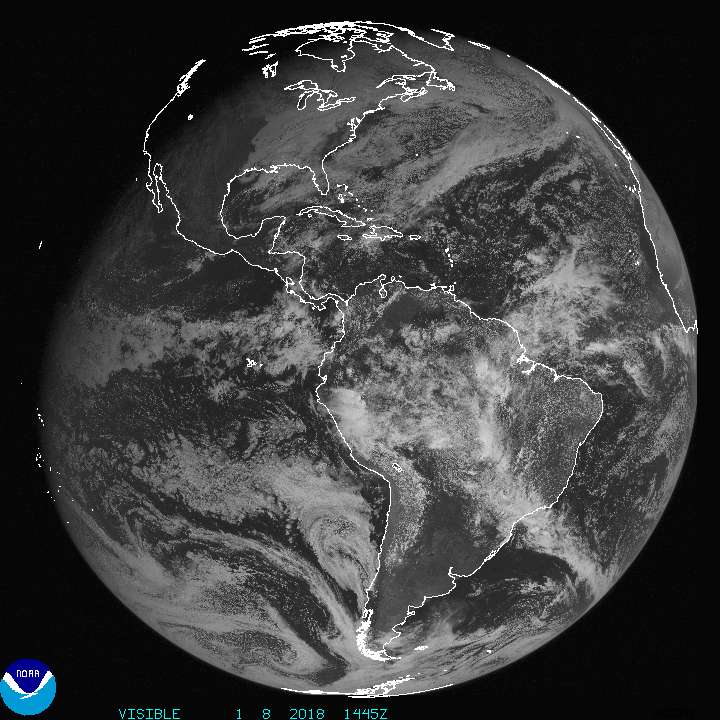
The image here is from the GOES West spacecraft, a geostationary spacecraft that provides visible and infrared imagery of the Earth in addition to other geophysical data. GOES stands for Geostationary Operational Environmental Satellites, of which GOES West is just one. The fleet of spacecraft orbit the Earth at 6.6 Earth radii, or just over 22,000 miles above the Earth's surface. Orbital mechanics operate such that at this distance a satellite orbits the Earth at the same speed as the Earth itself rotates. The result is a satellite permanently fixed above a single point on the Earth's surface. In the case of GOES West, that spot is far out in the Pacific Ocean. The spacecraft is able to continuously monitor an entire hemisphere from this vantage point. Hawaii is outlined up and to the left in the image, while North and South America are on the right. This image was taken just a few hours ago. I love looking at these images from time to time, they capture the beauty and enormous detail of our planet in a single frame.

http://www.goes.noaa.gov/goesfull.html

lunar eclipse this weekend

Feast your eyes on the moon saturday night as it will be passing through the shadow of the Earth, a truly enjoyable astronomical event. A lunar eclipse occurs when the Earth lines up in between the sun and the moon. The moon passes through the shadow of the Earth and takes on a palette of red colors. The red coloring is from sunlight passing through the Earth's atmosphere, just like a sunset generally looks reddish orange. The eclipse will be best seen from the eastern United States, beginning a little bit after sunset and lasting for a couple hours. Unfortunately, we western state types will not see any of the eclipse. The consolation is that a second lunar eclipse this year occurs on August 27th, and the western United States will be the prime viewing region.

Saturday, February 10, 2007

An Inconvenient Truth

I finally managed to see Al Gore's film on the environment and global warming today and I give the film a big thumbs up. Yes, the film can definitely be viewed as the centerpiece of a Presidential election vehicle and yes, the film contains a few too many wistful scenes of Al gazing out windows, but I give him high marks for trying his best to not only understand the science of global warming but present it to a mass audience without dumbing things down too much. The film moves back and forth between scenes of Gore giving his now famous lecture on global warming and glimpses into his life story and the parts that are relevant to the environmental movement. In his lecture, he shows the actual data that so clearly proves how we have changed our atmosphere. He exposes some of the absolutely irresponsible moves that have come out of the Bush White House regarding global warming, including the editing of scientific findings by a non-expert. Gore places the burden of proof upon himself, spending 90% of the time simply trying to convince us that the evidence is real before switching gears to tell us what we can do. My favorite aspect of the film is the presentation of data: atmospheric carbon dioxide levels, global population growth, global temperature trends, sea ice reduction, all presented on visually impressive graphs with Gore's caring and involved narration of their meaning. This is an important film, I highly recommend it.

www.climatecrisis.net

Tuesday, February 06, 2007

astro-nuts

Today was one of those pleasant days in the news where all the misery of the planet is pushed aside for a particularly bizarre story. The astronaut love triangle that has resulted in kidnapping and attempted murder charges for a recent astronaut is the stuff of a saturday night live skit, not the real world. I don't particularly care about the details, what I care about is making sure people keep this incident and the state of the overall astronaut corps separate. Lisa Nowak is clearly a troubled person, but her actions are not indicative of some kind of pervasive rot within the astronaut corps or the culture of NASA. Astronauts are a culturally diverse, highly educated, and extraordinarily brave group of people, but they are also human beings and even the best of us blow a gasket from time to time. Does NASA need to review some of it's psychological testing procedures for astronauts? Absolutely. But the idea that the astronaut corps is an unstable powder keg of psychos is just wrong. Unfortunately, this incident will likely be used as a broad brush to paint the astronaut corps as a mental pressure cooker and NASA as a failed manager of it's most visible employees. We've been spared the awful news of the world for a day, let's get back to worrying about the truly crazy people out there.

Sunday, February 04, 2007

Iraq wetlands on the mend

The enormous wetlands of the Tigris-Euphrates river basin, the home of the Mesopotamian civilizations of thousands of years ago, are making a comeback. The wetlands were systematically drained during the Hussein regime with little regard for the Iraqis who relied on the marshes for their livelihood and the wildlife that called them home. With the help of American forces, independent contractors, and ordinary Iraqis, 40% of the marshlands have been reflooded since 2003. Full ecological recovery is a long way off, but a clear sign of progress is the return of thousands of water birds to the region.